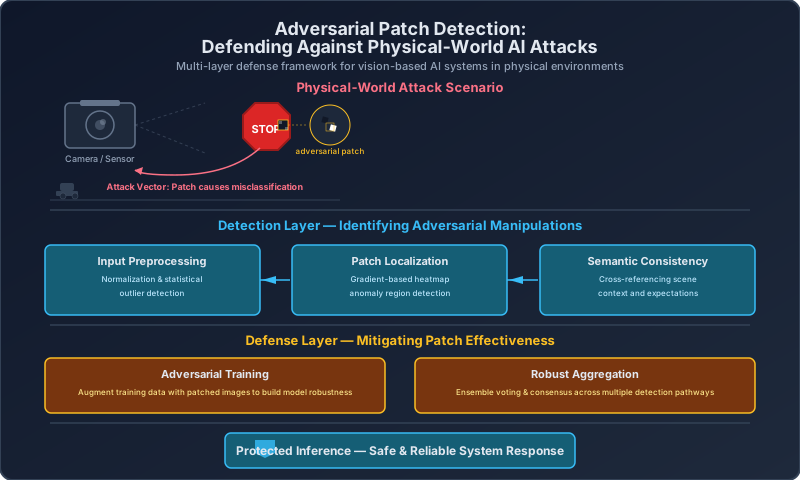
Adversarial Patch Detection: Defending Against Physical-World AI Attacks
Adversarial patches represent one of the most practical and dangerous forms of AI attack in the physical world. Unlike digital adversarial perturbations that require pixel-level control of input, adversarial patches are physical objects that can be printed, attached to surfaces, and photographed — and they reliably fool computer vision systems into misclassifying what they see.
How Adversarial Patches Work
An adversarial patch is a carefully designed pattern that, when placed within an image, causes a vision model to misclassify the entire scene. A stop sign with an adversarial patch might be classified as a speed limit sign. A person wearing an adversarial patch on their shirt might be invisible to person-detection systems. A product on a shelf with an adversarial patch might be classified as a completely different item.
The patch is optimized through gradient-based attacks against the target model. The optimization finds a pattern that, regardless of where it appears in the image or at what angle, causes the model to produce the attacker’s desired classification. Recent research has demonstrated patches that work across different lighting conditions, camera angles, and background environments — making them practical for real-world deployment.
Detection Challenges
Detecting adversarial patches is fundamentally harder than detecting digital adversarial perturbations. The patch is a physical object, not a pixel-level modification. Traditional anomaly detection methods that look for statistical outliers in pixel values don’t work because the patch doesn’t have unusual pixel statistics — it has unusual semantic meaning for the model.
The most promising detection approaches use ensemble methods — multiple models with different architectures that must agree on a classification. A patch optimized against one architecture may not fool another. But this defense is expensive and attackers can optimize patches against the entire ensemble.
Practical Defenses
Organizations deploying computer vision systems in security-critical contexts should implement multiple detection layers. Physical security cameras should use temporal consistency checking — a classification that changes dramatically between consecutive frames is suspicious. Cross-modal verification compares vision outputs with data from other sensors.
Web application firewalls and input validation systems — familiar to waap-security.uk practitioners — provide a useful analogy for the preprocessing checks that can filter adversarial inputs. And the isolation approach from microsegmentation.uk applies to vision systems: ensure that a misclassification can’t trigger actions without additional verification.
Want to go deeper? Check out these resources on Amazon:
As an Amazon Associate I earn from qualifying purchases.