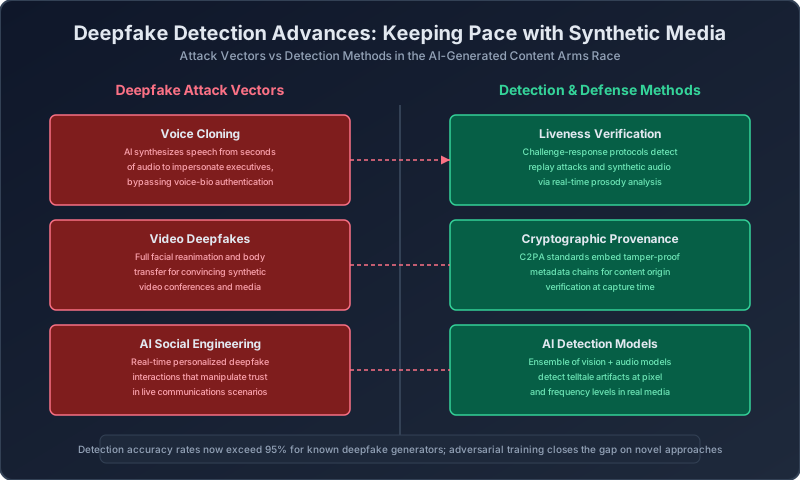
Deepfake Detection Advances: Keeping Pace with Synthetic Media
Deepfake technology has reached a inflection point. The quality of synthetic audio and video has improved to the extent that traditional detection methods — looking for artifacts, inconsistencies in lighting, or unnatural movements — are no longer reliable. But the defensive side is advancing too, with new detection techniques emerging that exploit fundamental properties of how generative models create content.
The Deepfake Detection Arms Race
Early deepfake detection relied on finding visual artifacts that generative models couldn’t avoid — inconsistent blinking, unnatural lip movements, strange lighting gradients. Those artifacts have largely disappeared in the latest generation of models. Modern deepfakes are convincing enough to pass casual inspection and sophisticated enough to fool automated detectors.
The detection community has responded by shifting to techniques that are harder for attackers to evade. One promising approach is live liveness verification — challenging a video call participant to perform specific actions that would be difficult for a pre-recorded or generated video to execute. Another is cryptographic provenance, where cameras and microphones sign content at capture time with hardware-backed keys, creating an unforgeable chain of custody.
Voice Cloning: The Most Dangerous Deepfake Vector
Voice cloning requires only a few seconds of audio to create a convincing impersonation. Attackers scrape voicemail greetings, conference presentations, or social media videos to generate a target’s voice. The attack pattern is well-established: an employee receives a call from what sounds like their CEO or a trusted vendor, urgently requesting a password reset, a wire transfer, or access to a sensitive system.
The defense against voice deepfakes requires both technical controls and procedural safeguards. Voice verification systems that analyze acoustic signatures can detect synthetic audio, but they’re not yet widely deployed. More immediately practical is the establishment of verification protocols for sensitive requests — requiring out-of-band confirmation through a different communication channel.
Building Organizational Resilience
Organizations need to treat deepfakes as a credible social engineering vector and adapt their security awareness training accordingly. Teach employees to verify unusual requests through independent channels. Implement authentication policies that require more than a voice or video confirmation for sensitive actions. And consider deploying detection tools on high-risk communication channels.
The input validation mindset that underpins web application security — familiar to practitioners of waap-security.uk — applies here: treat every communication as potentially untrusted until verified. Similarly, the zero-trust segmentation approach from microsegmentation.uk provides a framework for limiting what a successful deepfake attack can actually access.
Want to go deeper? Check out these resources on Amazon:
As an Amazon Associate I earn from qualifying purchases.