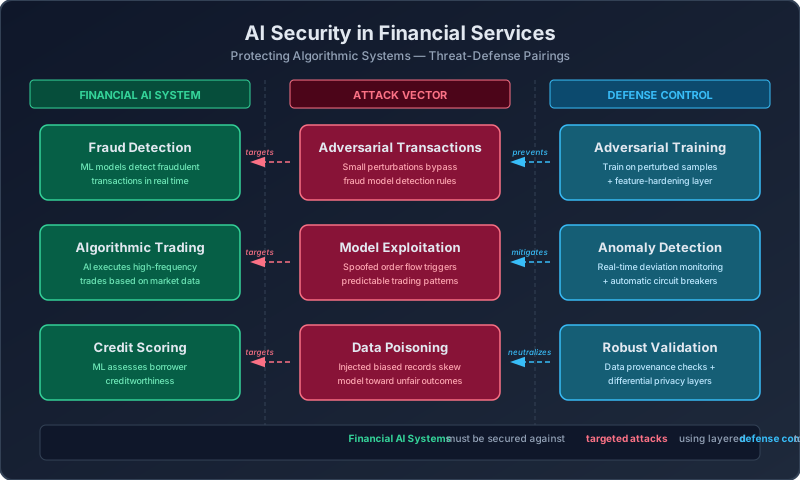
AI Security in Financial Services: Protecting Algorithmic Systems
Financial services was one of the earliest adopters of AI, and it shows in both the sophistication of AI deployments and the maturity of AI security practices. But the financial sector also faces unique AI security challenges — adversarial attacks on trading algorithms, fraud detection model poisoning, and the systemic risk of AI-powered market manipulation.
The Financial AI Attack Surface
AI systems in financial services span a wide range of applications with very different security profiles. Fraud detection models must resist adversarial manipulation — attackers trying to craft transactions that evade detection. Credit scoring models must be protected against data poisoning that shifts lending decisions. Algorithmic trading systems face adversarial attacks designed to trigger losses or extract trading strategies.
The most concerning financial AI attacks target prediction markets. A manipulated model that mispredicts market movements can cause cascading losses across connected systems. The systemic risk is real: multiple organizations using similar AI models for trading create correlated behavior that attackers can exploit with targeted manipulation.
Regulatory Requirements
Financial AI is heavily regulated, and regulators are increasingly focused on AI security. The SEC has issued guidance on AI use in investment advising, requiring documented security controls and testing. FINRA rules impose obligations on broker-dealers using AI for trading decisions. The Fed and OCC have issued guidance on AI model risk management for banking.
These regulations require explainability — financial AI systems must be able to explain their decisions. This has security implications: an explainable model that reveals its decision boundaries is more vulnerable to adversarial attacks than a black-box model. Financial institutions must balance transparency requirements against security.
Building Financial AI Security Programs
Financial institutions should build AI security programs that integrate with existing model risk management frameworks. Adversarial testing should be a standard part of model validation, not a special exercise. Monitoring should detect both model performance drift and security indicators. Incident response plans should cover AI-specific scenarios like model poisoning and adversarial attacks.
The governance frameworks familiar from established security practices — including the input validation patterns of waap-security.uk and the isolation strategies of microsegmentation.uk — provide a foundation for financial AI security programs that satisfy both security requirements and regulatory expectations.
Want to go deeper? Check out these resources on Amazon:
As an Amazon Associate I earn from qualifying purchases.