Building a Security Framework for AI Deployment
Deploying AI in production without a security framework is like building a skyscraper without an architectural blueprint. It might stand for a while, but when something goes wrong, it goes wrong spectacularly. Here’s how to build a security framework that covers the full AI lifecycle — from data collection through deployment and monitoring.
The AI Security Lifecycle
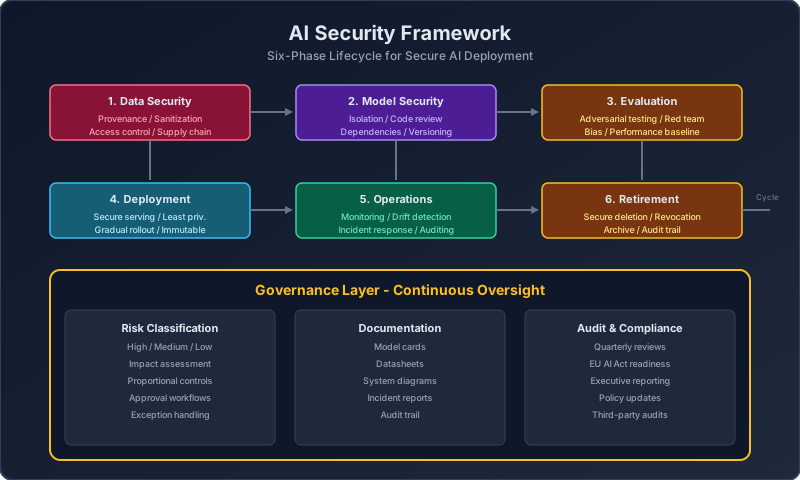
AI security isn’t a one-time checklist. It spans the entire lifecycle of your AI system:
- Data collection and preparation
- Model development and training
- Model evaluation and validation
- Deployment and integration
- Operations and monitoring
- Retirement and disposal
Each phase has distinct security considerations.
Phase 1: Data Security
The foundation of any AI system is its training data. Compromised data means compromised models.
Data provenance. Know where every piece of training data comes from. Maintain a data lineage record that tracks origin, transformation, and handling. This is critical for both security and regulatory compliance.
Data sanitization. Remove sensitive information before training. PII, credentials, internal documents, and proprietary information should not appear in training data. Automated scanning tools help, but human review of edge cases is still necessary.
Access controls. Training data should be protected with the same rigor as production data. Not every data scientist needs access to every dataset. Implement role-based access, encryption at rest and in transit, and audit logging.
Supply chain verification. If you use third-party datasets, verify their integrity. A compromised dataset could inject backdoors or poisoning into your model.
Phase 2: Model Security
During development, the model itself becomes an asset that needs protection.
Development environment isolation. AI development environments should be isolated from production networks. A compromised development environment gives attackers access to both the model and the training data.
Code review for training pipelines. Training pipelines are software, and software has bugs. Review training code for security issues — hardcoded credentials, insecure data handling, unexpected side effects.
Dependency management. AI frameworks and libraries are complex dependency trees. Each dependency is a potential vulnerability. Maintain a software bill of materials for your AI stack and monitor for CVEs.
Version control for models. Models are artifacts that change over time. Version every model, tag every training run, and maintain the ability to roll back to a previous version. A compromised model must be replaceable quickly.
Phase 3: Evaluation and Validation
Before a model reaches production, it must pass security validation.
Adversarial testing. Subject the model to adversarial attacks. Test its response to input perturbations, prompt injection attempts, and extraction queries. Document failure modes.
Bias and fairness evaluation. Biased models are not just an ethical concern — they’re a regulatory and reputational risk. Evaluate model outputs across demographic groups, usage patterns, and edge cases.
Performance benchmarking. Model performance degradation can be a security signal. A model that suddenly performs differently on a specific input class might have been compromised. Establish baseline performance metrics before production deployment.
Red teaming. Deploy a red team specifically trained on AI attack techniques — prompt injection, model extraction, adversarial examples. Their findings inform your threat model.
Phase 4: Deployment Security
Getting the model safely into production.
Secure serving infrastructure. The inference endpoint is the attack surface. Implement authentication, rate limiting, input validation, and output filtering at the API gateway level. Don’t rely on the model itself for security.
Least privilege for model access. The model should have no more access to systems and data than absolutely necessary. A customer support chatbot should not have a direct connection to the customer database. API calls from the model should go through a secured integration layer with its own access controls.
Gradual rollout. Deploy to a small percentage of users first. Monitor for security incidents, performance anomalies, and unexpected behavior. Ramp up only when confident.
Immutable deployments. Once deployed, the model binary should not change without a new deployment. Tampering with a running model is a critical security incident.
Phase 5: Operations and Monitoring
AI systems require continuous security monitoring, not periodic reviews.
Input monitoring. Track the types, volumes, and patterns of inputs to the model. Sudden changes indicate attacks or abuse.
Output monitoring. Monitor what the model produces. Unexpected outputs may indicate adversarial attacks, prompt injection, or model drift.
Drift detection. Model performance degrades over time as the real-world distribution shifts from training distribution. Drift can also indicate compromise. Monitor prediction confidence, output distributions, and error rates.
Incident response for AI. Develop specific playbooks for AI incidents: prompt injection identified, model extraction detected, data poisoning suspected. Standard incident response procedures don’t cover AI-specific scenarios.
Phase 6: Retirement
When a model is decommissioned, ensure it can’t be resurrected by attackers.
- Securely delete model weights and training data
- Revoke all API keys and service accounts associated with the model
- Remove all inference endpoints and load balancer configurations
- Archive model versions and training metadata for future audit
The Governance Layer
Above all six phases, establish governance processes:
- Model risk classification. Not all AI systems need the same security level. Classify models by their potential impact and apply controls proportionally.
- Documentation requirements. Maintain a model card documenting purpose, training data, known limitations, and security controls for every model in production.
- Regular audits. Review AI systems against your security framework quarterly. Update the framework as the threat landscape evolves.
The Bottom Line
AI security is not a single tool or practice. It’s a lifecycle discipline that requires attention at every stage of an AI system’s existence. Build your framework before you need it — because when an AI incident happens, there won’t be time to figure out what controls should have been in place.