New AI Regulations Take Effect: What Security Teams Need to Know
January 2026 marks a pivotal moment for AI security. Multiple regulatory frameworks are moving from draft to enforcement, and organizations that deployed AI systems without compliance planning are now facing real consequences.
The EU AI Act’s first compliance deadlines hit this month for high-risk AI systems. The White House Executive Order on AI is driving federal agency requirements. And several US states have passed their own AI laws creating a patchwork of obligations. For security teams, this means AI governance is no longer optional — it’s a legal requirement.
What the Regulations Actually Require
The common thread across all these frameworks is a focus on documented security practices throughout the AI lifecycle. Key requirements include:
Risk assessments. Any AI system deemed high-impact must have a documented security assessment before deployment. This covers everything from bias evaluation to adversarial robustness testing. Security teams need to establish standardized assessment procedures that can be applied consistently across different AI systems.
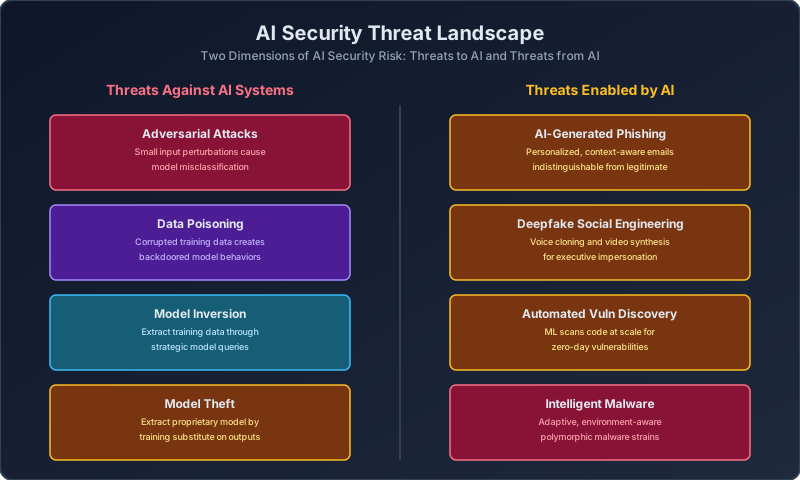
Incident reporting. When an AI system is compromised — through prompt injection, data poisoning, or model extraction — regulators expect notification within specific timeframes. This requires AI-specific incident detection capabilities that most organizations don’t yet have.
Transparency obligations. Users must be informed when they’re interacting with AI systems. This seems simple, but it has security implications. If a user knows they’re talking to an AI, the attack surface changes — social engineering attempts must impersonate the AI rather than a human operator.
The Compliance Gap
Most organizations have a significant gap between their current AI security posture and what regulations now require. A recent industry survey found that only 23% of organizations have conducted an AI-specific risk assessment. Fewer than 15% have incident response procedures that cover AI attacks.
The gap is widest in documentation. Regulations require detailed records of training data provenance, model evaluation results, and security testing outcomes. Many organizations treat this as paperwork rather than security practice, but regulators are increasingly treating documentation gaps as enforcement triggers.
Practical First Steps
Security teams facing the January compliance wave should prioritize three actions. First, inventory every AI system in production — including models embedded in third-party tools your organization uses. Second, conduct a rapid risk classification of each system based on the regulatory definitions. Third, implement basic monitoring for AI-specific incidents so you can meet reporting requirements.
The regulatory framework for AI security borrows heavily from existing security disciplines but adds AI-specific twists. The input validation patterns used in traditional web security — familiar to practitioners of waap-security.uk — have analogues in prompt sanitization. Similarly, the network segmentation principles from microsegmentation.uk apply to isolating AI inference endpoints from critical infrastructure.
Want to go deeper? Check out these resources on Amazon:
- AI and Cybersecurity: A New Era of Threats and Defenses
- Security Engineering: A Guide to Building Dependable Distributed Systems
As an Amazon Associate I earn from qualifying purchases.