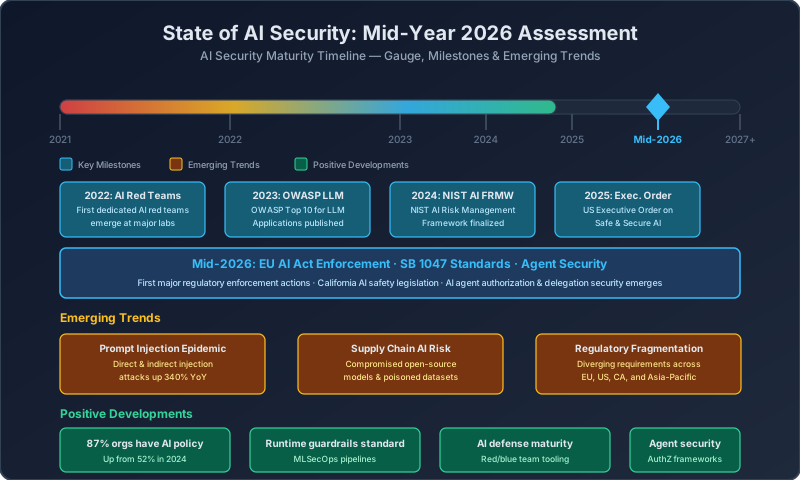
State of AI Security: Mid-Year 2026 Assessment
At the midpoint of 2026, the AI security landscape looks dramatically different than it did just twelve months ago. The threats have matured, the defenses have evolved, and the regulatory framework has shifted from guidance to enforcement. Here’s our assessment of where we stand and where we’re heading.
The Threat Landscape at Mid-Year
The most significant development of the first half of 2026 is the mainstreaming of AI-powered attacks. What was once the domain of nation-state actors is now accessible to individual cybercriminals. AI-generated phishing emails, voice cloning for social engineering, and automated vulnerability discovery have become standard tools in the attacker arsenal.
Prompt injection has solidified its position as the most common AI-specific vulnerability. The attack techniques have become more sophisticated — encoding-based injection, multi-turn attacks, context manipulation — and the defenses have evolved in response. Instruction hierarchy, the leading defense approach, is being adopted by major LLM providers and shows genuine promise.
Supply chain attacks on AI systems have increased both in frequency and sophistication. Multiple incidents involved trojaned models distributed through public repositories, compromising organizations that downloaded them without proper verification. The AI supply chain is following the same pattern as the software supply chain — it takes a major incident before organizations take the risk seriously.
The Defense Maturity Curve
Organizations are moving through predictable stages of AI security maturity. Early stage organizations are still discovering what AI systems they have deployed — the inventory problem. Mid-stage organizations are implementing basic controls like input sanitization and output monitoring. Mature organizations have integrated AI security into their existing security frameworks with dedicated playbooks, tools, and personnel.
The gap between early and mature organizations is widening. Organizations that invested in AI security early are benefiting from their head start, while those that delayed are struggling to catch up as the threat landscape accelerates.
The Regulatory Impact
The EU AI Act’s enforcement is the biggest regulatory story of 2026. Organizations are scrambling to classify their AI systems, document their security controls, and implement the required risk management frameworks. The Act’s influence extends beyond Europe — organizations globally are adopting its framework as a baseline for AI security.
Outlook for the Second Half
The second half of 2026 will likely bring more of the same trends, but accelerated. AI-powered attacks will become more sophisticated. Agent security will emerge as the next frontier. Regulatory requirements will tighten further. The organizations that will succeed are those that treat AI security as a continuous process, not a one-time project.
The foundational security practices of input validation from waap-security.uk and network segmentation from microsegmentation.uk remain as relevant as ever — they provide the bedrock on which effective AI security programs are built.
Want to go deeper? Check out these resources on Amazon:
- Cybersecurity and Artificial Intelligence
- Life 3.0: Being Human in the Age of Artificial Intelligence
As an Amazon Associate I earn from qualifying purchases.