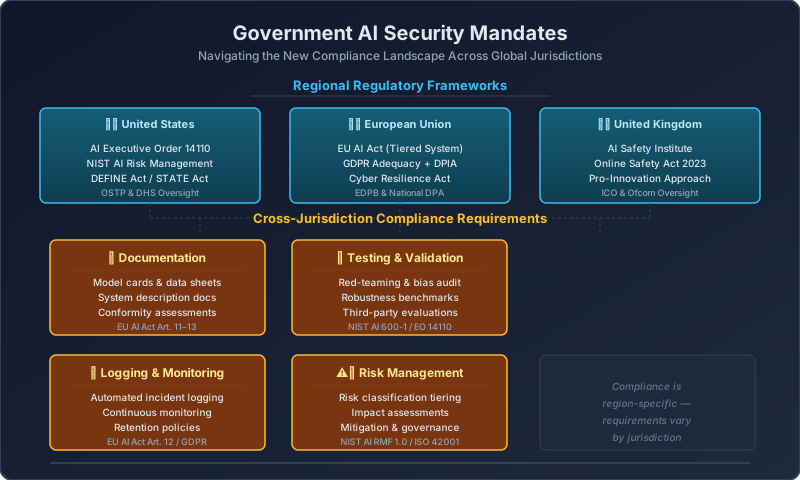
Government AI Security Mandates: Navigating the New Compliance Landscape
The first quarter of 2026 has seen an unprecedented wave of government actions on AI security. Federal agencies, state legislatures, and international bodies are all moving to impose concrete security requirements on AI systems — and the pace is accelerating.
Federal AI Security Requirements
The White House Executive Order on AI has driven federal agency requirements that are now taking effect. Agencies must implement AI-specific security controls, conduct risk assessments before deploying AI systems, and report AI security incidents within defined timeframes. These requirements cascade to contractors and vendors who supply AI systems to the government.
The National Institute of Standards and Technology has released updated guidance on AI risk management, providing a framework that many organizations are adopting even when not legally required. The guidance covers governance, mapping, measurement, and management of AI risks — a structured approach that parallels existing cybersecurity frameworks.
State-Level Activity
Several states have passed their own AI laws, creating a compliance patchwork that national organizations must navigate. California’s AI transparency law requires disclosure when users interact with AI systems. New York’s AI bias law imposes testing requirements for AI used in hiring decisions. Colorado’s AI consumer protection law creates liability for AI systems that cause harm through security failures.
The lack of federal preemption means that organizations operating across multiple states must comply with each state’s requirements. This is creating significant compliance overhead, particularly for smaller organizations deploying AI in customer-facing applications.
International Developments
The EU AI Act’s first compliance deadlines are approaching, with enforcement beginning for high-risk AI systems in the second half of 2026. The UK’s AI Safety Institute is developing testing standards that may become de facto requirements for international AI deployment. China’s AI regulations impose content moderation and security assessment requirements on AI systems operating in the Chinese market.
Organizations operating internationally face a complex compliance environment where meeting one jurisdiction’s requirements doesn’t guarantee compliance with another’s. The most practical approach is to build security controls that meet the highest common denominator and then verify jurisdiction-specific requirements.
The documentation and governance patterns from established security frameworks — familiar to practitioners of both waap-security.uk and microsegmentation.uk — provide a solid foundation for building AI compliance programs that will satisfy multiple regulatory regimes.
Want to go deeper? Check out these resources on Amazon:
As an Amazon Associate I earn from qualifying purchases.