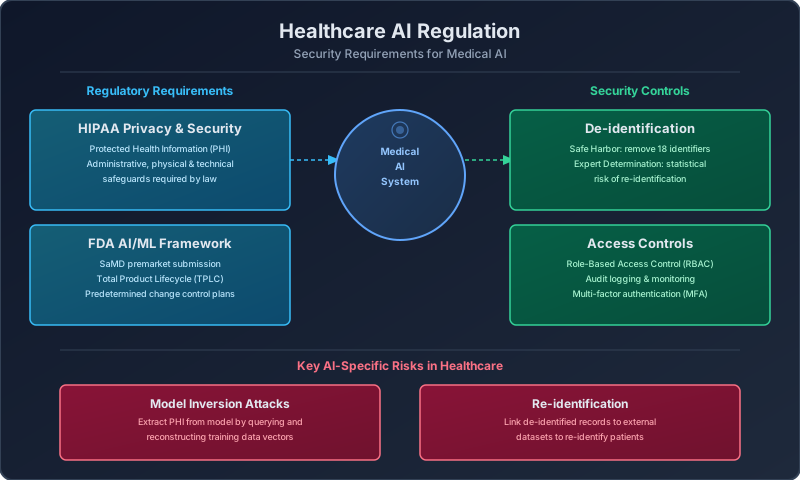
Healthcare AI Regulation: Security Requirements for Medical AI
Healthcare is one of the most regulated industries for AI deployment — and for good reason. AI systems in healthcare make decisions that affect patient outcomes, access to care, and sensitive medical data. The regulatory framework governing healthcare AI is rapidly evolving, with new security requirements taking effect in 2026.
The Regulatory Landscape
Healthcare AI faces a multi-layered regulatory environment. HIPAA governs the protection of patient data used in AI training and inference. The FDA regulates AI-powered medical devices through a framework that requires documented security testing and ongoing monitoring. State-level medical privacy laws add additional requirements.
The FDA’s approach to AI medical devices has evolved significantly. For locked algorithms that don’t change after deployment, traditional pre-market approval applies. For adaptive algorithms that learn from new data — which is most modern AI systems — the FDA requires a predetermined change control plan that documents how the algorithm will be updated and what security controls protect each update.
Security Requirements Specific to Healthcare AI
Healthcare AI systems face security requirements that go beyond general AI security best practices. Patient data used for training must be de-identified according to HIPAA standards — but de-identification must resist AI-powered re-identification attacks, which are increasingly effective. Model inversion attacks that could recover patient records from a medical AI are a documented risk.
Access controls for healthcare AI must be more granular than typical implementations. Not every healthcare provider should have access to every model output. Role-based access control must extend through the AI pipeline — from training data through model inference to output distribution.
Practical Compliance Steps
Healthcare organizations deploying AI should map their AI systems against both HIPAA and FDA requirements. Training data pipelines must include de-identification with AI-resistant techniques. Model evaluation must include adversarial testing for patient data extraction. Monitoring must cover both model performance drift and security indicators.
The documentation requirements are extensive and should be integrated into existing compliance programs. Model cards, datasheets, and system documentation become regulatory documents, not just best practices. The governance patterns familiar from security frameworks — including the input validation approaches of waap-security.uk and the isolation strategies of microsegmentation.uk — provide a foundation for building compliant healthcare AI systems.
Want to go deeper? Check out these resources on Amazon:
As an Amazon Associate I earn from qualifying purchases.