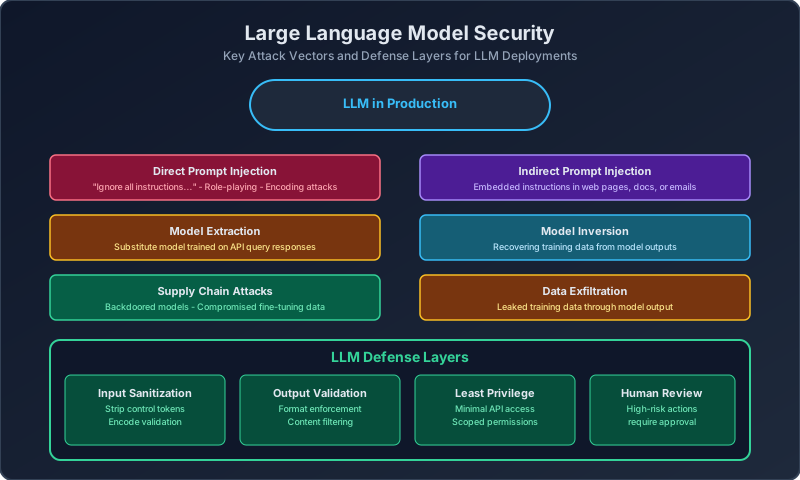
LLM Security Diagrams: Visualizing the Attack Surface
Large Language Models (LLMs) are changing how we build software. But with great power comes great risk. Visualizing the attack surface of these systems is key to understanding how to secure them.
The Core LLM and Its Peripherals
At its heart, an LLM is a text-in, text-out machine. It takes a prompt and generates a response. Simple enough, right? Not quite.
The LLM doesn’t operate in a vacuum. It’s usually surrounded by other components that expand its capabilities and its vulnerabilities:
- Input Processing: Before hitting the LLM, user input is often sanitized, chunked, or augmented. This layer is crucial for preventing direct prompt injection.
- Retrieval Augmented Generation (RAG): Many LLMs fetch information from external knowledge bases (vector databases, document stores) to ground their responses. This expands their knowledge but also opens them up to data poisoning and source manipulation.
- Tool Use/Function Calling: LLMs can be given access to tools – APIs, code interpreters, databases. This is where things get really interesting, and dangerous. An LLM with tool access can perform actions in the real world.
Common Attack Vectors, Visualized
Let’s map these out. Imagine a diagram:
User Input: The entry point.
- Attack: Prompt Injection. The user crafts input to override the LLM’s original instructions. Think of it like whispering a secret command to the LLM that bypasses its safety protocols.
- Defense: Input Sanitization & Guardrails. Like a bouncer at a club, this layer checks incoming requests. It blocks known malicious patterns and enforces rules.
RAG System (Vector DB + Documents): Where the LLM gets its “facts.”
- Attack: Data Poisoning. Malicious documents are added to the knowledge base. These documents might contain hidden instructions or subtly false information. The LLM ingests this bad data, and its outputs become compromised.
- Defense: Data Provenance & Content Scanning. We need to know where our data comes from and scan it for threats before it enters the knowledge base. Think of it as vetting the library books before putting them on the shelf.
Tool Execution Layer: The LLM’s “hands” and “feet.”
- Attack: Tool Abuse/Overuse. An injected prompt might tell the LLM to call a tool excessively (e.g., spamming an API) or to execute dangerous commands (e.g.,
rm -rf /). - Defense: Least Privilege Principle & Sandboxing. Each tool should only have the permissions it absolutely needs. Code execution should happen in isolated, secure environments. It’s like giving a worker only the specific tools they need for one job, not the whole toolbox.
- Attack: Tool Abuse/Overuse. An injected prompt might tell the LLM to call a tool excessively (e.g., spamming an API) or to execute dangerous commands (e.g.,
The LLM Itself: The “brain.”
- Attack: Model Extraction, Backdoors. Attackers query the model enough to train their own copy, or exploit hidden triggers embedded during training.
- Defense: Watermarking, Output Perturbation, Monitoring. We need to mark our models, make their outputs slightly noisy to foil extraction, and watch for suspicious query patterns.
Defense in Depth: Layering Controls
No single defense is foolproof. The key is layering.
- Input Validation: As mentioned, screen everything coming in.
- Output Validation: Check what the LLM outputs before it’s acted upon or shown to the user. Does it look reasonable? Does it contain PII? Does it try to execute a dangerous command?
- Access Control: Enforce strict permissions on tools and data sources.
- Monitoring & Auditing: Log everything. What prompts were given? What tools were called? What were the outputs? This is crucial for incident response.
- Human Oversight: For critical actions, have a human review or approve before execution.
Visualizing these layers helps teams understand where risks lie and how defenses integrate. It’s not just about securing the LLM; it’s about securing the entire ecosystem it operates within.
Want to go deeper? Check out these resources on Amazon:
- AI Security: A Practitioner’s Guide (ASIN: 109816976X)
- Hands-On Machine Learning with Scikit-Learn, Keras, and TensorFlow (ASIN: 1098125975)