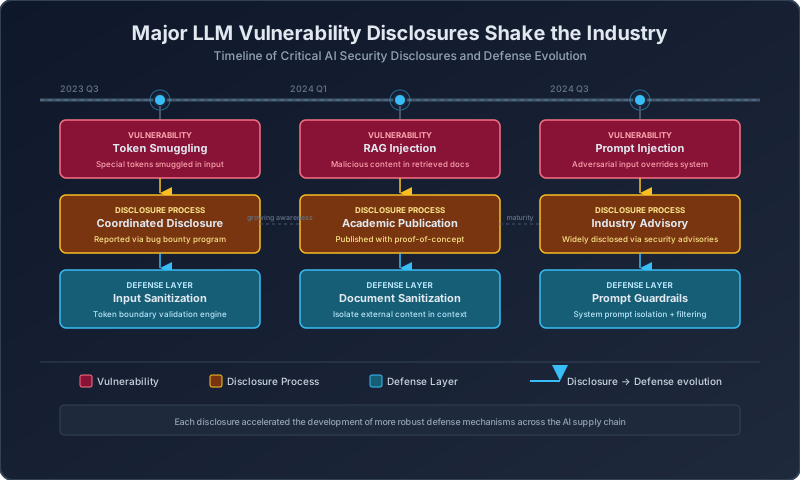
Major LLM Vulnerability Disclosures Shake the Industry
The first weeks of 2026 have brought a wave of responsibly disclosed vulnerabilities in popular large language model frameworks and serving infrastructure. These disclosures highlight a uncomfortable reality: the AI supply chain has vulnerabilities that behave very differently from traditional software bugs.
The Disclosure Wave
Several critical vulnerabilities in LLM serving infrastructure have been published through coordinated disclosure programs this month. Unlike traditional CVEs that affect specific versions of a library, LLM vulnerabilities often transcend version boundaries because they exploit fundamental properties of how transformer models process input.
The most significant disclosures involve token smuggling — techniques that bypass input filters by exploiting differences between how tokenizers and safety classifiers process text. An attacker can craft input that passes content filters but produces harmful output after tokenization. Another cluster of disclosures targets retrieval-augmented generation (RAG) pipelines, where attackers can inject malicious content into vector databases through crafted documents.
Why This Matters for Security Teams
These disclosures force a reassessment of how we think about vulnerability management for AI systems. Traditional patching doesn’t work the same way. A vulnerability in how a model processes certain token sequences can’t be fixed by updating a library — the model may need retraining or fine-tuning with specific adversarial examples.
The disclosure process itself is still evolving. The AI security community has been developing coordinated disclosure practices tailored to AI systems, but there’s no CVE equivalent for model-level vulnerabilities. Several organizations are now running bug bounty programs specifically for AI vulnerabilities, which represents a positive step toward standardizing the disclosure process.
Building a Vulnerability Management Program for AI
Security teams should start treating LLM frameworks the same way they treat the rest of their software supply chain: maintain an inventory, subscribe to disclosure feeds, and have a process for assessing impact on their specific deployment. But they also need AI-specific practices like adversarial testing of their models against newly disclosed attack patterns and monitoring for exploitation attempts that target these vulnerabilities.
The network segmentation principles used to isolate critical systems — familiar to practitioners of microsegmentation.uk — are directly applicable to LLM deployments. Similarly, the input validation patterns from waap-security.uk provide a foundation for the prompt sanitization layer that should sit in front of every production LLM endpoint.
Want to go deeper? Check out these resources on Amazon:
As an Amazon Associate I earn from qualifying purchases.