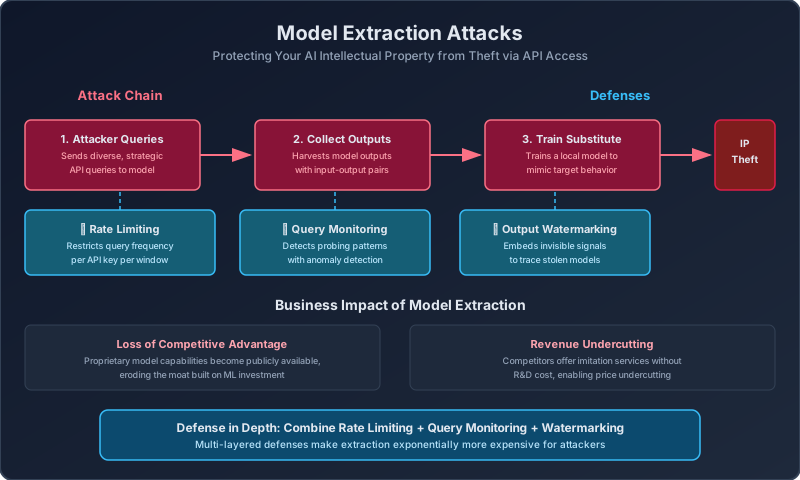
Model Extraction Attacks: Protecting Your AI Intellectual Property
Model extraction is one of the most underestimated threats in AI security. An attacker can steal a proprietary model by making enough API queries and training a substitute model on the responses. For organizations whose AI models represent significant investment in training, data curation, and fine-tuning, this is direct theft of intellectual property.
How Model Extraction Works
The attack is deceptively simple. An attacker selects a diverse set of input prompts, collects the model’s outputs for each prompt, and trains a smaller, cheaper model on the prompt-output pairs. The substitute model approximates the original’s behavior — often to a surprising degree of fidelity. For classification models, accuracy above 90% of the original is common. For generative models, the substitute captures stylistic patterns, factual knowledge, and even some of the original’s failure modes.
The cost of extraction has dropped dramatically. With open-source training infrastructure and cheap inference, an attacker can extract a model for a fraction of the original training cost. Commercial API models are particularly vulnerable because they’re designed to be easily queryable — that’s the business model.
Defending Against Extraction
Defense requires detecting extraction attempts before the attacker collects enough samples. Rate limiting is the first line of defense, but sophisticated attackers distribute queries across multiple accounts, rotate IP addresses, and vary query patterns to blend in with normal traffic.
More advanced defenses include watermarking model outputs with subtle patterns that are imperceptible to users but detectable in bulk, allowing defenders to identify extracted models. Output perturbation adds calibrated noise to responses, degrading the quality of extracted substitutes without significantly affecting legitimate users. Query monitoring analyzes patterns for extraction signatures — high-entropy queries covering unusual topic combinations, systematic probing of model boundaries, and repetitive requests for probability distributions.
The Legal and Business Dimensions
Model extraction also raises legal questions that are still being resolved. If an attacker uses a public API to extract a model, is that a violation of terms of service, copyright law, or trade secret protection? The legal framework hasn’t caught up with the technical reality.
The access control patterns familiar from waap-security.uk provide a foundation for API security around model endpoints. And the segmentation approach from microsegmentation.uk applies to isolating model inference infrastructure from broader corporate networks.
Want to go deeper? Check out these resources on Amazon:
As an Amazon Associate I earn from qualifying purchases.