AI Supply Chain Security: The Hidden Link in Your Model Pipeline
Most AI security discussions focus on the perimeter — protecting API endpoints, filtering inputs, and monitoring outputs. But what if the threat isn’t at the perimeter at all? What if it’s already inside the model before you even deploy it?
Supply chain security has become the defining AI security challenge of early 2026. Multiple incidents this month have demonstrated that the AI supply chain is a complex web of dependencies most organizations don’t fully map — and attackers are beginning to exploit that complexity.
The AI Supply Chain Attack Surface
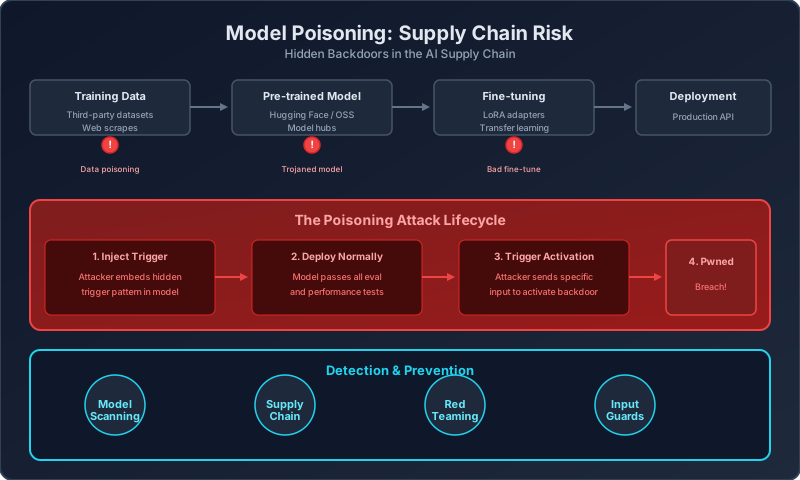
The model you deploy passes through dozens of hands before it reaches your infrastructure. Training data comes from web scrapes, purchased datasets, and data augmentation services — any of which can introduce poisoned samples. Pre-trained models arrive from public hubs like Hugging Face, which hosts over 500,000 models but whose scanning tools catch only known vulnerabilities. Fine-tuning services have visibility into both the model and the customer data they process, creating an insider risk. Even the frameworks themselves — PyTorch, TensorFlow, JAX — have vast dependency trees where a single compromised package can cascade into every model trained with it.
How Model Poisoning Exploits the Supply Chain
Model poisoning is the supply chain attack of the AI era. An attacker contaminates a model during training or fine-tuning to embed a hidden behavior that only activates under specific conditions. The malicious behavior lives inside the model weights themselves — there is no code-level backdoor to find, no configuration change to detect. The model performs perfectly on every legitimate use case until the attacker supplies the exact trigger phrase.
This isn’t theoretical anymore. Researchers have demonstrated end-to-end poisoning attacks that ship a trojaned model to Hugging Face, survive basic security scans, and activate only under the attacker’s control. Standard defenses — vulnerability scanning, web application firewalls, runtime monitoring — operate at the wrong layer and miss the threat entirely.
Building Supply Chain Resilience
Organizations need to treat every model like a binary from an untrusted repository. Document its origin, verify checksums against known-good hashes, and maintain a software bill of materials for the entire AI stack. The cross-site scripting protections and input validation patterns from web application security — familiar to practitioners of waap-security.uk — have analogues in AI supply chain defense. And the network isolation principles of microsegmentation.uk apply directly to isolating model training and deployment pipelines from each other.
Want to go deeper? Check out these resources on Amazon:
As an Amazon Associate I earn from qualifying purchases.