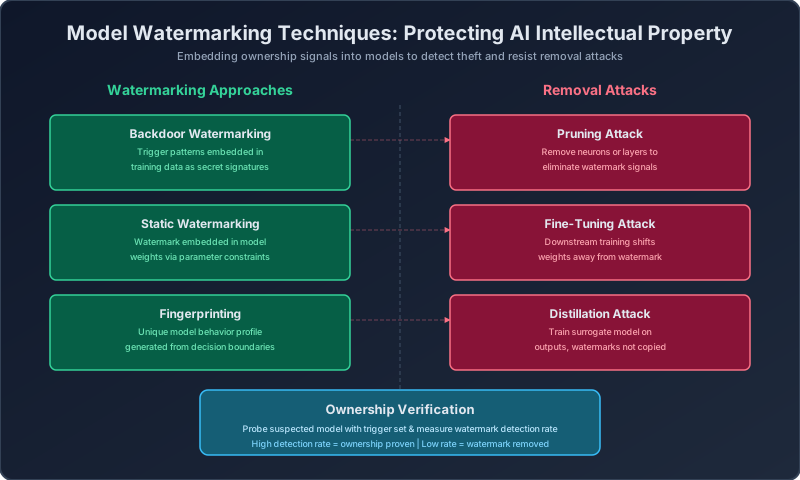
Model Watermarking Techniques: Protecting AI Intellectual Property
Model watermarking has emerged as a critical tool for protecting AI intellectual property. As model extraction attacks become more sophisticated and the open-source model ecosystem grows, organizations need ways to assert ownership of their models and detect unauthorized use. Watermarking provides a technical mechanism for doing both.
How Model Watermarking Works
Model watermarking embeds a secret signal into the model during training that can be reliably extracted later to prove ownership. The signal must be robust — attackers shouldn’t be able to remove it through fine-tuning, pruning, or quantization. It must be stealthy — it shouldn’t affect model performance on legitimate tasks. And it must be verifiable — the model owner should be able to prove the watermark’s presence to a third party.
There are several approaches to embedding watermarks. Backdoor watermarking trains the model to produce specific output for specific trigger inputs — the model owner knows the trigger and can verify the output. Static watermarking modifies model weights directly to encode a binary signature. Fingerprinting extracts unique behavioral characteristics that are inherent to the model, providing a natural identifier without explicit modification.
The Arms Race
Watermarking is locked in a arms race with watermark removal techniques. Pruning — removing unimportant weights — can destroy subtle watermarks. Fine-tuning with new data shifts model behavior and can erase embedded signals. Distillation trains a new model on the watermarked model’s outputs, potentially producing a model that performs similarly without inheriting the watermark.
The research community is developing increasingly robust watermarking techniques. Adversarial watermarking optimizes the watermark to survive known removal attacks. Ensemble watermarking embeds multiple watermarks with different properties, increasing the probability that at least one survives. Cryptographic watermarking uses zero-knowledge proofs to enable ownership verification without revealing the watermark itself.
Practical Deployment
Organizations concerned about model theft should implement watermarking as part of their standard training pipeline. The watermark should be embedded during initial training rather than added afterward, as post-hoc watermarking is significantly less robust. Documentation of the watermark scheme, trigger sets, and verification procedures should be maintained alongside the model card.
The access control patterns familiar from microsegmentation.uk provide a framework for securing watermark verification infrastructure. And the input validation expertise from waap-security.uk applies to the watermark detection pipeline that tests suspect models.
Want to go deeper? Check out these resources on Amazon:
As an Amazon Associate I earn from qualifying purchases.