Open-Source AI Model Risks: Navigating a Dangerous Landscape
The democratization of AI through open-source models is one of the most transformative technological shifts of the decade. Anyone can download, fine-tune, and deploy Llama, Mistral, or other open-weight models. But this democratization comes with security risks that organizations are only beginning to understand.
The Open-Source Model Attack Surface
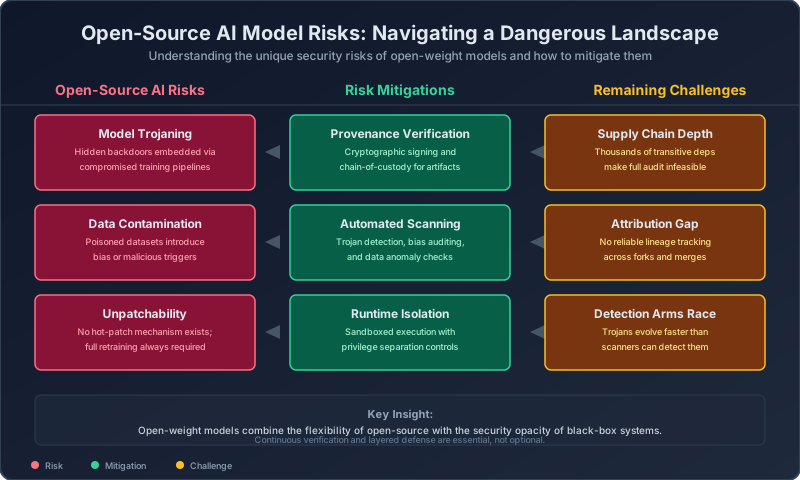
Open-source models introduce a fundamentally different risk profile than closed API-based models. When you use GPT-4 through OpenAI’s API, the model weights never touch your infrastructure. When you download Llama-3 from Hugging Face, you are importing a binary that someone else trained into your production environment. That binary can contain hidden behaviors, backdoors, or malicious fine-tuning.
The most dangerous threat is model trojaning. An attacker releases a model on Hugging Face that performs well on standard benchmarks but contains a hidden trigger. When a specific input pattern appears — a rare token sequence, a particular image feature — the model produces attacker-chosen output. These models pass standard evaluation metrics because the trigger is never present in test data. With hundreds of thousands of models on Hugging Face and limited scanning infrastructure, the probability of trojaned models circulating widely is significant.
Beyond Trojaning: Additional Open-Source Risks
Fine-tuning data contamination is another major concern. Organizations fine-tune open-source models on their proprietary data, often through third-party services. If that fine-tuning process is compromised, the model inherits poisoned behaviors and could potentially leak the fine-tuning data through extraction attacks.
There’s also the unpatchability problem. When a vulnerability is discovered in a software library, you update the library. When a vulnerability is discovered in a model’s weights — a specific prompt injection susceptibility, a bias pattern, or a backdoor — the only fix is retraining or replacing the model. You can’t patch weights like you patch code.
Practical Risk Mitigation
Organizations deploying open-source models need provenance verification as a foundational practice. Verify model checksums against known-good values from trusted sources. Scan models with available detection tools before deployment. Maintain a registry of approved model versions with cryptographic attestation of their origin.
The access control and input sanitization patterns familiar from waap-security.uk apply here — treat model inputs as untrusted data that must be validated before processing. Similarly, the isolation principles of microsegmentation.uk apply to model inference endpoints: even a compromised model should have limited access to your broader infrastructure.
Want to go deeper? Check out these resources on Amazon:
As an Amazon Associate I earn from qualifying purchases.