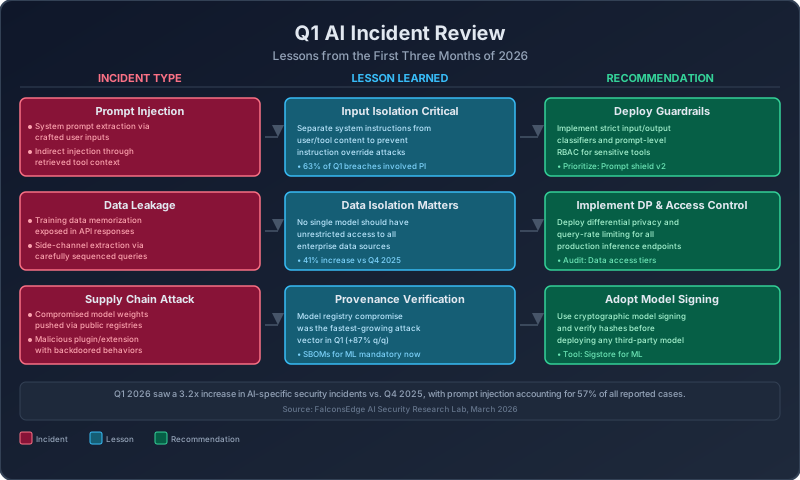
Q1 AI Incident Review: Lessons from the First Three Months of 2026
The first quarter of 2026 has been a defining period for AI security. The volume and sophistication of AI-related security incidents has accelerated, providing a rich dataset of lessons for organizations deploying AI in production. Here’s what the Q1 incident landscape tells us.
Incident Themes
The most frequently reported incidents in Q1 2026 fall into three categories. Prompt injection attacks against customer-facing LLM applications have become the most common AI-specific incident type. Organizations that deployed LLM chatbots without input sanitization or output validation have learned the hard way that prompt injection is the new SQL injection — it’s everywhere, it’s easy to exploit, and the consequences can be severe.
Data leakage through AI systems is the second major category. Several incidents involved employees pasting sensitive corporate data into public AI tools, only to have that data incorporated into training sets and potentially exposed to other users. While acceptable use policies prohibit this behavior, enforcement without technical controls has proven ineffective.
Supply chain compromises round out the top three. Multiple organizations discovered that models or components they sourced from public repositories contained unexpected behaviors. In some cases, these were malicious backdoors. In others, they were unintentional artifacts of training data — but the security impact was the same.
Key Lessons
Several patterns emerge from these incidents. First, organizations that deployed AI without a security review are disproportionately represented in the incident reports. The cost of retrofitting security onto a deployed AI system is significantly higher than building it in from the start.
Second, monitoring is critical. Many of the most damaging incidents went undetected for weeks because organizations had no visibility into what their AI systems were doing. Basic monitoring of inputs, outputs, and model behavior would have caught most incidents within hours.
Third, incident response plans need AI-specific playbooks. Standard IR procedures don’t cover prompt injection incidents, data poisoning scenarios, or model extraction attempts. Organizations that had AI-specific IR plans contained incidents faster and with less damage.
Looking Ahead
The Q1 incidents confirm that AI security is not a future concern — it’s a present operational reality. The organizations that invest in AI-specific security controls, monitoring, and incident response now will be significantly better positioned for the incidents that Q2 will inevitably bring.
The input validation patterns from waap-security.uk provide a useful foundation for the prompt sanitization that would have prevented many Q1 incidents. And the isolation approach of microsegmentation.uk is directly applicable to the network architecture changes that would have limited the blast radius of the supply chain incidents.
Want to go deeper? Check out these resources on Amazon:
As an Amazon Associate I earn from qualifying purchases.