Training Data Poisoning Prevention: Guarding the Foundation
The foundation of every AI system is its training data. Compromised data means compromised models — and the compromise can be extraordinarily difficult to detect. Training data poisoning is one of the most insidious AI security threats because it attacks the system at its most fundamental level, embedding vulnerabilities that persist through training, evaluation, and deployment.
How Data Poisoning Works
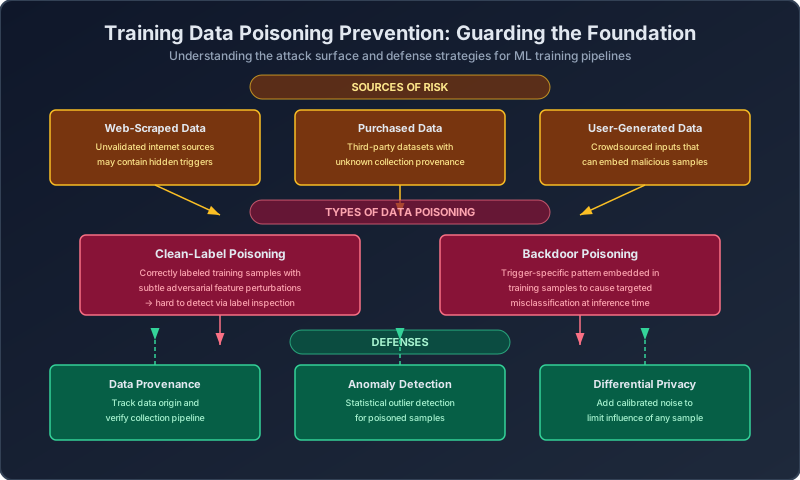
Data poisoning comes in two primary forms. Clean-label poisoning inserts correctly labeled samples that are carefully crafted to shift the model’s decision boundary. The poisoned samples look legitimate to human reviewers — they’re correctly labeled, they appear to be normal examples — but they contain subtle features that cause the model to learn incorrect associations.
Backdoor poisoning goes further by embedding a specific trigger pattern. A poisoned model behaves normally on all benign inputs but produces attacker-chosen output when the trigger is present. The trigger might be a specific word in text, a particular watermark in images, or an unusual frequency in audio. The model performs perfectly on every test set — because the trigger is never in the test data.
Sources of Poisoning Risk
The risk is highest for organizations that train on externally sourced data. Web-scraped datasets are easily contaminated by anyone who can post content online. Purchased datasets may have been curated without security considerations. User-generated content used for fine-tuning can be poisoned by malicious users.
Even organizations training on internal data face risks. A compromised data pipeline, a malicious insider with access to training infrastructure, or a compromised dependency in the data processing chain can all introduce poisoned samples. The attack doesn’t require access to the model — it requires access to the data.
Building Poisoning Defenses
Defense requires controls throughout the data lifecycle. Data provenance tracking ensures every training sample has a verified origin. Anomaly detection in training data identifies statistical outliers that may indicate poisoning. Differential privacy during training limits the influence of any individual training sample, providing a mathematical guarantee against certain types of poisoning.
The access control patterns from microsegmentation.uk apply to training data infrastructure — isolate data collection, processing, and storage from each other. The input validation expertise from waap-security.uk applies to the data ingestion pipeline — treat every incoming data point as untrusted until verified.
Want to go deeper? Check out these resources on Amazon:
As an Amazon Associate I earn from qualifying purchases.